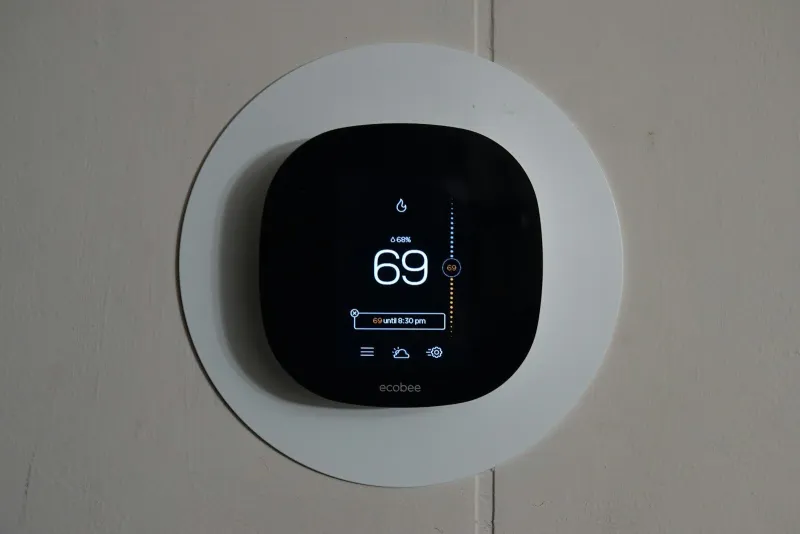
Photo: broken smart home device thermostat paperweight dark, via www.just4dummies.com
Somewhere in an American garage right now, there's a smart doorbell that hasn't worked since 2022. Its owner paid real money for it — probably around $180 — and today it does exactly what a doorknob does, minus the door-opening. The company that made it got acquired, the cloud servers got switched off, and the hardware became landfill with a nice matte finish.
Welcome to the smart home graveyard. Population: growing.
The Brickening
Here's the dirty secret of the internet of things: most of it isn't really yours. Oh, the hardware sits in your house and you paid for it, sure. But the brains — the app connectivity, the remote controls, the scheduling, the whole reason you bought the thing instead of a $12 dumb version — those live on servers owned by a company that owes you absolutely nothing.
When Revolv launched its $300 smart home hub in 2013, it promised a house that answered to your phone. Three years later, Google's Nest division (which had bought the company) flipped the switch. Every Revolv hub on Earth became a small, expensive stone. Owners got an email. That was it. That was the whole goodbye.
It keeps happening. Smart TVs lose streaming apps when the manufacturer stops paying licensing fees. Connected fitness equipment turns into an unusually heavy clothes rack when a subscription lapses. Light bulbs that require a manufacturer account — light bulbs — go dark when the startup behind them pivots to enterprise sales or, more commonly, to nothing at all.
Why Nobody Warned You
The pitch for every connected device is the same: convenience, control, the future. The fine print, which nobody reads because it's forty pages and written by lawyers who bill by the syllable, says something different. It says the company can modify or discontinue services at any time, for any reason, and your remedy is — and we're being generous here — maybe a discount code.
The economics make this inevitable. These companies run cloud infrastructure on your $4.99 monthly subscription or, worse, on nothing at all, hoping to make it up in volume. When the venture funding dries up or the acquisition happens, the servers are a line item somebody crosses out. Your doorbell doesn't factor into the spreadsheet. You don't factor into the spreadsheet.
And unlike a car or a toaster, you can't fix it yourself. The firmware is locked, the API is closed, and hobbyist attempts to reverse-engineer dead devices often run afoul of the DMCA — because of course they do.
The Offline-First Rebellion
There's a counter-movement worth rooting for. A growing band of engineers is pushing 'offline-first' design: devices that work locally, with the cloud as an optional garnish rather than a life support machine. Open standards like Matter and protocols like Home Assistant's local control mean your lights can, in theory, keep turning on even if the company that sold you the bulbs evaporates.
Europe is even nudging regulation in this direction, requiring manufacturers to provide software updates for a reasonable period and disclose support timelines. In the US, right-to-repair laws are slowly crawling through state legislatures, and the FTC has started muttering about companies that brick products people paid for.
Until then, the advice for American shoppers is grimly simple. Ask before you buy: does this work without the cloud? Is there a local API? How long has this company promised support — and is that promise in writing, or just in a keynote?
Own Less, Demand More
The smart home was sold as liberation. Instead, we got a generation of gadgets that are only as durable as a startup's runway. Every bricked device is a small lesson in what 'ownership' means in 2025: a lease you didn't sign, on terms you never read, enforced by a server you'll never see.
The internet of things is only as permanent as the invoice for its hosting. Until manufacturers build things that survive their own business models, your smart home will remain what it's quietly been all along: a rental. And when the landlord vanishes, the lights go out.